
Is there a Mac app with ElevenLabs quality that I only pay for once?
Yes. txt2mp3 is a Mac app that generates speech from a model sitting on your own disk, for a single payment. You download the app, it fetches the model once during setup, and after that every take renders on the Mac's own silicon. No credits, no character counter, no monthly bill to keep alive.
The model is VoxCPM2, a two-billion-parameter text-to-speech model released under Apache-2.0. Its authors report state-of-the-art or competitive results on the major zero-shot and controllable text-to-speech benchmarks, it covers 30 languages, and it outputs 48 kHz audio. That is the quality claim, and it is checkable: the model card is public and the trial in the app speaks 120 characters before you pay anything.
What one payment actually gets you
The second take is free. So is the ninth. A retake stops being a budget decision and becomes an editing decision, which is the only change here that alters how you work rather than what you spend. The generator also keeps working after you stop paying, because there is nothing to stop paying for.
Where ElevenLabs is still the better buy
At low volume, nothing bought outright competes. ElevenLabs' free tier covers about ten minutes of text-to-speech a month, and the $6 Starter plan covers about thirty and adds a commercial licence. If you publish a few minutes a month, stay there. A cloud library is also ahead on breadth of voices, on dubbing, on team seats and on running through an API at scale. And txt2mp3 is Apple silicon only, so a Windows or Linux edit bay rules it out before the price does.
Does ElevenLabs work offline?
No. Every ElevenLabs render happens on their servers, so each take needs a connection and spends credits from your plan. There is no local mode, no offline export of the model, and no way to generate on a plane.
A local engine inverts both halves of that. After a one-time model download, generation runs on the machine in front of you: it works with the network off, and there is no service on the other end with anything to count. The privacy property people notice first, that a script never leaves the machine, is a side effect of the same architecture rather than the reason to pick it.
ElevenLabs cost per minute, worked out from credits
ElevenLabs prices in credits, so the per-minute number has to be derived. Their pricing page gives every piece: one text character equals one credit for the V2 Multilingual models, and each plan's credit quota is listed next to its text-to-speech minutes. The Creator plan's 121,000 credits are stated as about 121 minutes, which puts a spoken minute at roughly 1,000 characters.
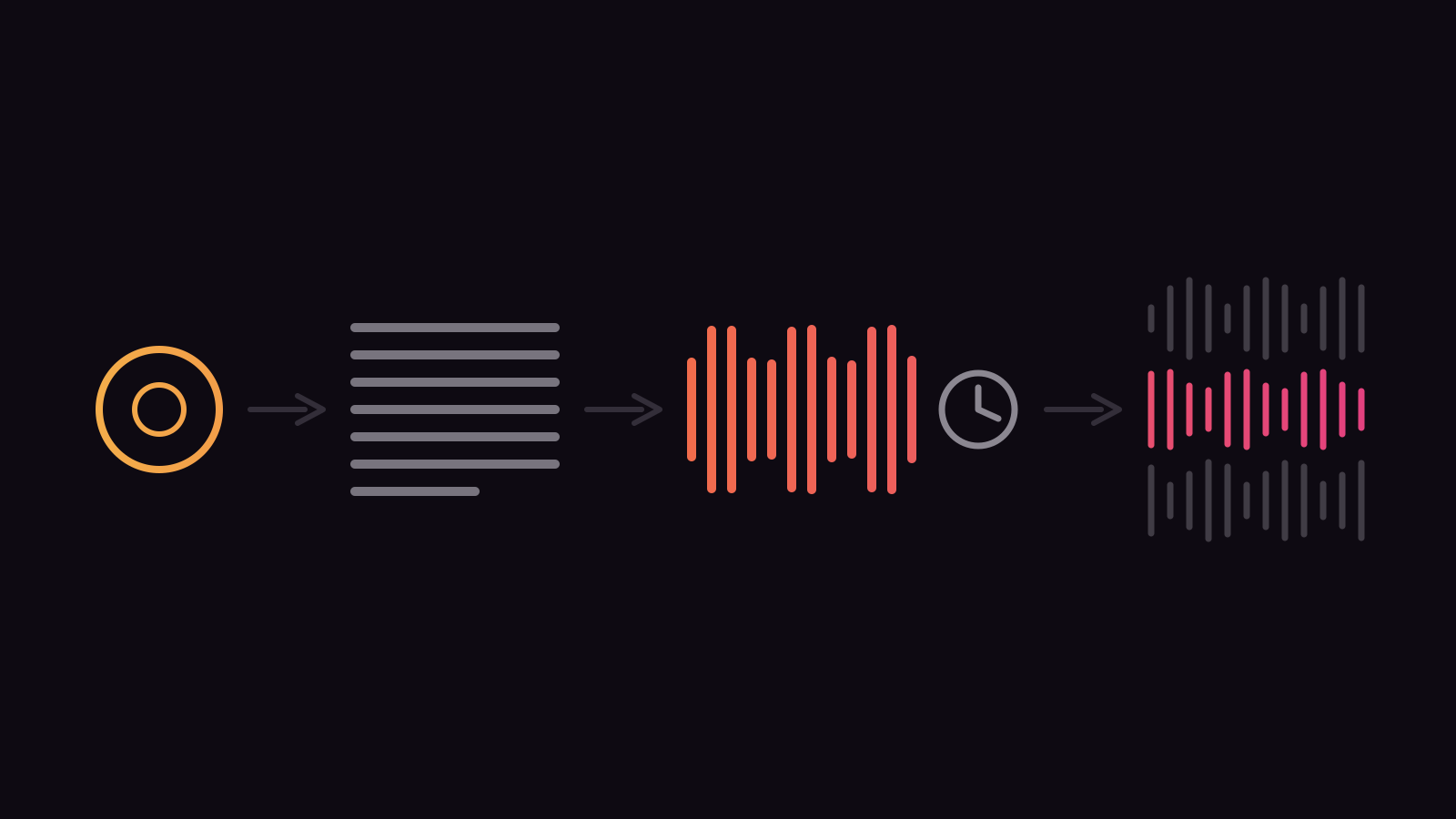
Divide each plan by its minutes and the rate barely moves:
| Plan | Monthly | Credits | TTS minutes | Per included minute | Per extra minute |
|---|---|---|---|---|---|
| Free | $0 | 10,000 | ~10 | — | ~$0.36 |
| Starter | $6 | 30,000 | ~30 | $0.20 | ~$0.20 |
| Creator | $22 | 121,000 | ~121 | $0.18 | ~$0.18 |
| Pro | $99 | 600,000 | ~600 | $0.17 | ~$0.17 |
| Scale | $299 | 1,800,000 | ~1,800 | $0.17 | ~$0.17 |
| Business | $990 | 6,000,000 | ~6,000 | $0.17 | ~$0.17 |
Overage rates against plan rates
The interesting column is the last one, and the interesting thing about it is that it is boring. An extra minute costs about what an included minute costs on the same plan. Going over is not the trap; there is no cliff to fall off and no punitive rate to avoid.
The rate itself is the trap, because it never expires. Every minute you will ever publish costs about eighteen cents, in month one and in month forty. That is the number a one-time purchase is aimed at, not the overage.
The retake multiplier nobody prices
A finished minute of narration is not a generated minute. A name comes out wrong, a line lands flat, a sentence gets rewritten once you hear it read. Two takes per section is a modest habit for anyone who cares how the read sounds, and it doubles the generated minutes behind every published one.
So Creator's 121 minutes are about 60 published minutes at two takes, or 40 at three. The real cost per published minute is $0.36 and $0.55, not $0.18. An eight-minute script is around 1,200 words at a steady reading pace, near 7,000 characters, so two takes of it draw about 14,000 credits before anything reaches the timeline. The same arithmetic worked out per video, at four, twelve and thirty uploads a month, is in our guide to the best AI voice for faceless YouTube.
There is a third multiplier in the same pool. All ElevenLabs products draw from one shared monthly credit allowance, and speech-to-text costs 330 credits a minute while dubbing costs 2,000 to 10,000. Caption an episode through the same account and the characters come out of the narration budget.
Subscription vs one-time purchase: the break-even math
Put both prices on one timeline and the comparison stops being about features. A monthly plan draws a staircase. A purchase draws a flat line. The only question worth answering is where they cross.
txt2mp3's price is a ladder that rises as copies sell rather than a discount that expires: $29 for the launch batch, then $69, then $99 as the standing price. Both ends are in the table below, because the honest break-even depends on which one you pay.
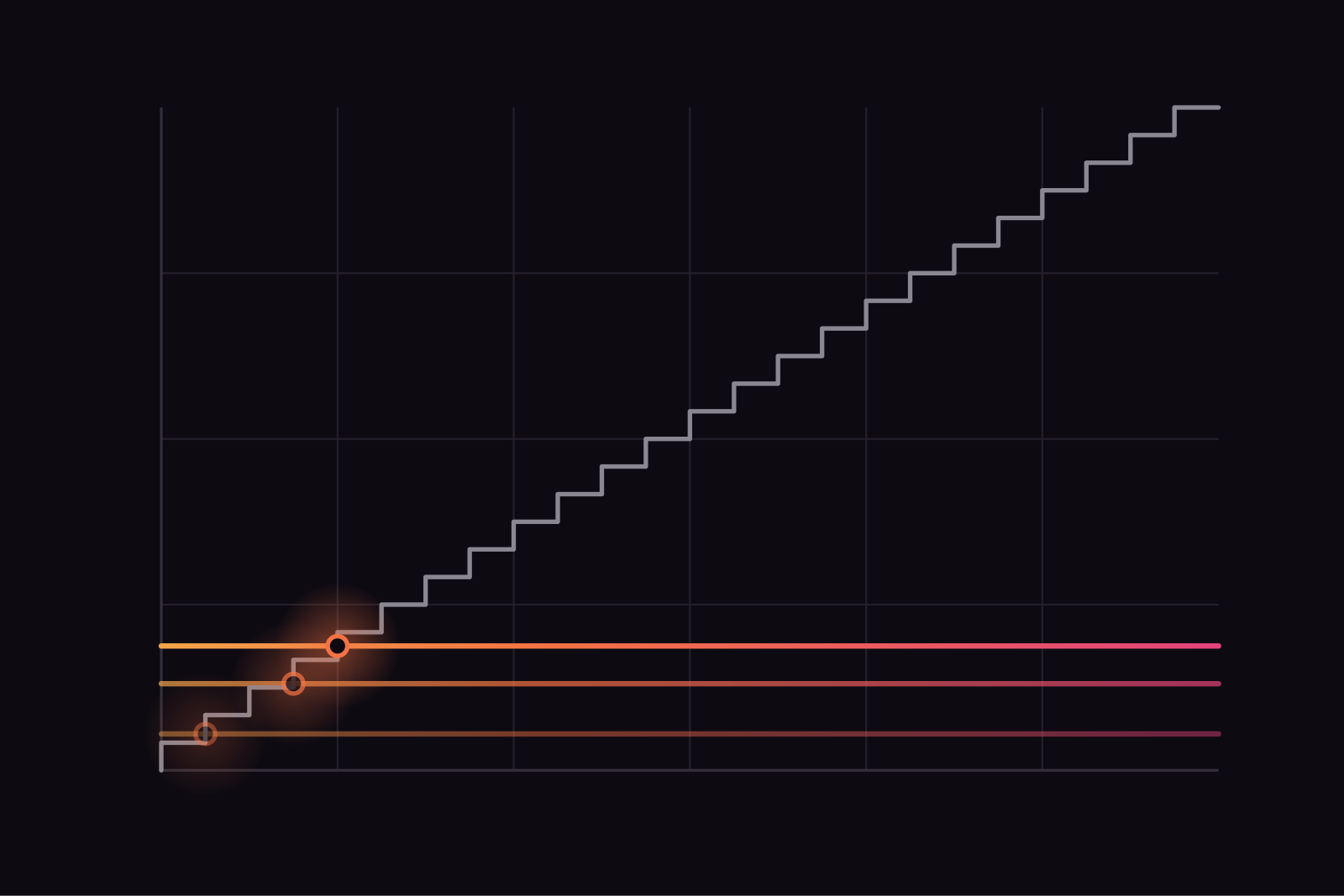
| Plan | 12 months | 24 months | Break-even at $29 | Break-even at $99 |
|---|---|---|---|---|
| Starter $6 | $72 | $144 | month 5 | month 17 |
| Creator $22 | $264 | $528 | month 2 | month 5 |
| Pro $99 | $1,188 | $2,376 | month 1 | month 1 |
| txt2mp3 | The price, once | The same price | — | — |
Two adjustments make the subscription column slightly kinder, and neither changes the shape. Creator's first month is half price at $11, which brings a first year to $253. Annual billing works out to two months free, so a year of Creator paid up front is $220 and the break-even against the $99 standing price moves from month five to month six.
Break-even by monthly output
The plan you need is set by generated minutes, not published ones, so the retake habit picks the tier. At two takes:
| Published minutes a month | Generated minutes | Cheapest plan that covers it | Break-even at $29 |
|---|---|---|---|
| 15 | 30 | Starter, $6 | month 5 |
| 60 | 120 | Creator, $22 | month 2 |
| 100 | 200 | Pro, $99 | month 1 |
| 300 | 600 | Pro, $99 | month 1 |
Every row after the first pays the purchase back inside a quarter. And the direction only goes one way: heavier output moves the crossing earlier, because more volume raises the subscription total and leaves the purchase price where it is.
What cancelling ElevenLabs actually forfeits
Cancelling is not a neutral act, and the exit cost belongs in the monthly price. ElevenLabs' pricing page states it plainly: if you downgrade or cancel your subscription, any unused paid credits will expire.
Rollover exists but is tied to the same subscription. Unused credits roll over for up to two months, up to twice the monthly quota, so a balance can reach at most three times the quota. That balance is a feature of an active plan, not a bank account. It leaves when the plan does.
Three other things end with the last payment. The commercial licence is a plan feature that first appears on Starter, so the right to publish what you generate is rented rather than owned. Professional voice cloning is a plan feature too, from Creator up, and the clone lives in the account rather than on your disk. What you keep, unambiguously, is the audio you already exported.
A local app has no equivalent event, which is the whole argument in one sentence. The model, the voices you cloned and every file you rendered are on your own drive, and files do not expire.
What a lifetime deal usually leaves out
"One-time payment" is a crowded phrase, and most of what it labels is a lifetime account rather than a lifetime tool. Two patterns are worth recognising before you buy anything sold that way.
The first is a cap that survives the purchase. Speechelo advertises no monthly fees and a one-time investment, at $47 against a stated $97 list price, with over 30 voices and English plus 23 other languages. Its own FAQ then sets the limit: you cannot have more than 700 words per voiceover. Nothing restricts how many voiceovers you make, but a 700-word ceiling is a meter wearing different clothes, and the commercial licence sits in the optional PRO upgrade rather than in the price.
The second is a reseller in the middle. A lot of text-to-speech products are a front end over someone else's API. Textalky names OpenAI among the models behind its voices and meters characters on every plan, from $6 a month for 80,000 up to $59 for a million. A price like that is not a property of the tool, it is a markup on a call to a third party, and no purchase you make changes who owns the meter. The durable version of buying once has to put the model on your own machine.
Three questions for anything sold as one-time
Does a meter survive the purchase?
A monthly character allowance, a words-per-render cap or a fair-use ceiling is still a meter, whatever the price page calls it.
Whose machine runs the model?
If generation happens on a server, the deal depends on that server staying up and staying affordable. If it happens on yours, it does not.
Is the commercial licence in the price?
Ask whether publishing what you generate needs an upgrade, and whether the grant survives you stopping payment.
How txt2mp3 runs studio-grade speech on Apple silicon
Setup downloads about 5 GB once: the speech model and the Python runtime that drives it. After that the app runs the model on the Mac's own silicon. There is no account, no server in a render, and no network call in the loop, which is the mechanism behind every claim above about free retakes.
Apple silicon text to speech, measured
On the Mac we develop on, loading the model takes 18.4 seconds and a short take renders in 5.5 seconds. The load costs more than three times a render, so the app keeps the model resident: the first take of a session pays for the load, and every take after it pays 5.5 seconds. That ratio is what makes a three-take habit practical instead of tedious.
The model card's own speed figures are for NVIDIA hardware, quoting a real-time factor near 0.3 on an RTX 4090 and about 8 GB of VRAM. On a Mac the unified memory does that job, which is why this ships as a packaged app with no terminal and no discrete GPU requirement. The hardware floor is an Apple silicon Mac and the disk space; the full checklist sits in our guide for video creators.
Clone a voice or design one
VoxCPM2 clones from a short reference recording, and it can also generate a novel voice from a written description with no reference audio at all. In the app that means three routes to a narrator: 14 presets across seven origins, a clone made from a recording you own, or a voice described in words. All three end up as files in your library.
Exports are MP3 at 192 kbps or WAV, with word-level caption timings aligned on the same
machine. Once the app is licensed, a local MCP server on 127.0.0.1:3062, off by default, lets
an AI agent list voices, generate a take and export the file without anyone opening the window.
ElevenLabs vs txt2mp3: which one fits your work
| Dimension | ElevenLabs Creator ($22/mo) | txt2mp3 (one-time) |
|---|---|---|
| Cost over 24 months | $528 | $29 today, $99 standing |
| Metering | 121,000 credits a month, about 121 minutes | None |
| A second take | Draws on the same monthly credits | Free, about 5.5 seconds |
| Offline | No, every render is a server request | Yes, after the one-time download |
| Commercial licence | A plan feature, from Starter up | Granted in the purchase |
| Voice cloning | Instant from Starter, professional from Creator, held in the account | From a recording on your disk |
| Platform | Any browser | Apple silicon Mac only |
| If you stop paying | Unused paid credits expire; exported audio stays yours | Nothing stops |
Who should stay with ElevenLabs
Low volume, first. Ten minutes a month is free and thirty is $6, and no purchase beats that. Then breadth: a catalogue of character voices, dubbing, languages past the 30 a local model covers, team seats, and an API you call from your own software. Anyone on Windows or Linux is also outside this comparison, since txt2mp3 does not run there.
Who should buy once
One narrator, many minutes, every week, on a Mac. That is the profile whose metered bill grows fastest and whose retakes are the most expensive part of caring about the read. If your generated minutes clear a hundred a month, the arithmetic above is not close, and the trial speaks 120 characters so you can judge the voice before any of it matters.
Frequently asked questions
At what usage does buying a TTS app outright beat my ElevenLabs subscription?
Divide the one-time price by your monthly plan price. Against the $22 Creator plan, the $29 launch price is repaid in month two and the $99 standing price in month five; against the $6 Starter plan those become month five and month seventeen. Heavier usage only moves the crossing earlier, because the subscription total climbs with your output while the purchase price does not. Annual billing on Creator works out to two months free, which delays the crossing by about a month.
What do I lose if I cancel my ElevenLabs subscription?
ElevenLabs' pricing page states that downgrading or cancelling expires any unused paid credits, and rollover, capped at two months and three times the monthly quota, only exists while the plan is active. The commercial licence is a plan feature from Starter up, so the right to publish new audio ends with it, and professional voice clones live in the account rather than on your disk. Audio you already exported remains yours.
Can I keep my ElevenLabs cloned voice when I switch to a local app?
Not the voice itself, because it exists server-side as an account asset. What transfers is your own reference recording. Clone from it again locally and the result is a file on your disk that works offline and cannot be switched off by a lapsed plan. If the original reference is gone, record a fresh one; a short clip is enough.
Is a local model as consistent as ElevenLabs for long narration?
Long-form consistency is still where the cloud leaders lead, and pretending otherwise would make the rest of this page worth less. VoxCPM2 reports competitive results on zero-shot and controllable benchmarks, which is a claim about samples rather than about a forty-minute read. The local counterweight is that fixing drift costs nothing, so you re-render the wobbly paragraph instead of rationing characters.
Do TTS lifetime deals mean unlimited generation?
Usually not. Speechelo advertises no monthly fees and then caps a single voiceover at 700 words, and its commercial licence sits in an optional upgrade. Others resell cloud voices, which makes the deal only as durable as someone else's API pricing. Check two things before buying: whether a meter survives the purchase, and whether the model runs on your machine or on a server.
Does a local text to speech app need a gaming GPU?
Not on a Mac. The VoxCPM2 model card quotes about 8 GB of VRAM and real-time factors measured on an RTX 4090, which is what most open-source guides are describing. On Apple silicon the unified memory serves the same role, and on our development Mac a short take renders in 5.5 seconds with the model already loaded. The requirement is an Apple silicon Mac and roughly 5 GB of free disk.
Where the numbers came from
ElevenLabs pricing
elevenlabs.io/pricingPlan prices, credits and text-to-speech minutes (Free $0 / 10,000 / ~10, Starter $6 / 30,000 / ~30, Creator $22 / 121,000 / ~121, Pro $99 / 600,000 / ~600, Scale $299 / 1.8M / ~1,800, Business $990 / 6M / ~6,000); extra-minute rates of ~$0.36, ~$0.20, ~$0.18 and ~$0.17; one credit per character for the V2 Multilingual models and 0.5 to 1 credit per character for Flash and Turbo via the API; the 50% first-month discount that shows Creator at $11; annual billing working out to two months free; the single shared credit pool across products, with speech-to-text at 330 credits a minute and dubbing at 2,000 to 10,000; the commercial licence starting at Starter; instant voice cloning at Starter and professional cloning at Creator; rollover for up to two months, up to 2x the monthly quota and a balance of at most 3x; and that downgrading or cancelling expires any unused paid credits. Fetched September 2026.
VoxCPM2 model card
huggingface.co/openbmb/VoxCPM2The model txt2mp3 runs: two billion parameters under Apache-2.0, 30 languages plus nine Chinese dialects, 48 kHz output, cloning from a short reference clip and zero-shot voice design from a written description, state-of-the-art or competitive results on major zero-shot and controllable text-to-speech benchmarks, and the NVIDIA figures of about 8 GB of VRAM and a real-time factor near 0.3 on an RTX 4090. Fetched September 2026.
Speechelo
speechelo.com"No Monthly Fees, One Time Investment" at $47 against a stated $97 normal price, over 30 voices, English plus 23 other languages, the FAQ's limit of no more than 700 words per voiceover with no cap on the number of voiceovers, and the optional PRO upgrade that carries the commercial licence. Fetched September 2026.
Textalky
www.textalky.comMonthly plans at $6 for 80,000 characters, $12 for 120,000, $29 for 250,000 and $59 for one million, with annual equivalents; no one-time or lifetime plan on the vendor's own site; and OpenAI named among the models behind the voices. Fetched September 2026.
txt2mp3 terms
/termsThat the speech you generate is yours, that we claim no ownership of it and receive no copy, and that you are free to use the audio commercially.
txt2mp3, measured first-hand
Model load of 18.4 seconds and a 5.5-second short take on our development Mac; the roughly 5 GB one-time setup download of model and runtime; the Apple silicon requirement; 14 preset voices across seven origins; cloning from one short recording; MP3 export at 192 kbps or WAV; word-level caption alignment; the 120-character trial; the local MCP server on 127.0.0.1:3062, off by default and off while the app is unlicensed; and the $29 launch, $69 and $99 one-time price ladder. The two-takes-per-section habit and the 150-words-a-minute reading pace behind the 1,200-word eight-minute script are stated assumptions in the worked examples, not measurements.